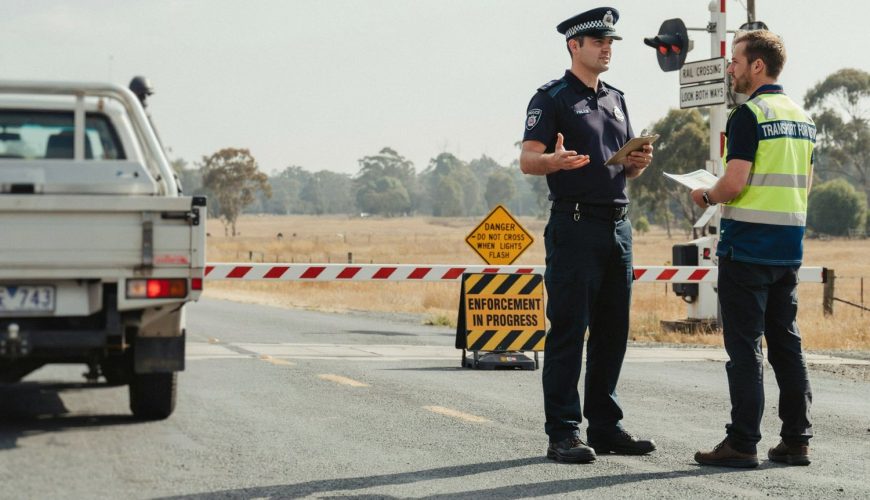
Truck drivers travelling through regional New South Wales are being urged to exercise extra caution around rail level crossings, with police and transport authorities launching a dedicated enforcement campaign aimed at reducing risky behaviour.
The two-week operation focuses on several level crossings across the Northern Tablelands region, where a history of incidents and near misses has raised ongoing safety concerns.
Increased Enforcement Underway
Transport for NSW and NSW Police have commenced a targeted safety campaign running from June 15 to June 26, with officers conducting patrols and compliance checks at level crossings in:
- Wollun
- Kentucky
- Uralla
The operation is designed to improve driver awareness and encourage safer decision-making at rail crossings.
Motorists caught breaching level crossing rules can face penalties of:
- A $562 fine
- Three demerit points
A Serious Safety Issue
While many drivers understand the risks associated with rail crossings, authorities say too many motorists continue to underestimate the speed of approaching trains or ignore warning signals altogether.
Statistics from the past decade highlight the seriousness of the issue.
Since 2015, there have been:
- 73 collisions between trains and road vehicles at level crossings across NSW
- 9 fatalities
- 10 serious injuries
Importantly, the overwhelming majority of these incidents occurred in regional areas.
Authorities have also recorded multiple near misses at the level crossings being targeted during the current campaign.
Why Rail Crossings Demand Respect
One of the biggest misconceptions among drivers is how quickly trains can approach and how difficult they are to stop.
Many freight and passenger trains can travel at speeds of up to 160 km/h.
Even more concerning is the stopping distance required.
A train travelling at speed can take up to 1.4 kilometres to come to a complete stop after emergency braking is applied.
That means that even if a train driver sees a vehicle on the tracks, there is often little they can do to avoid a collision.
Important Reminder for Heavy Vehicle Drivers
For truck drivers, the risks can be even greater.
Heavy vehicles require longer stopping distances, take longer to accelerate, and may be carrying heavy loads that make manoeuvring more difficult.
When approaching a rail crossing, drivers should:
- Obey all signs, signals, and warning devices
- Never attempt to beat an approaching train
- Allow additional travel time when planning journeys
- Approach crossings cautiously, particularly in unfamiliar areas
- Ensure there is sufficient space on the opposite side before crossing
A few extra seconds of patience can prevent a life-changing incident.
Safety First
Rail level crossings remain one of the highest-risk points on the road network, particularly in regional Australia where crossings may be encountered more frequently and train movements can be less predictable.
The current enforcement campaign serves as a reminder that rail crossing rules exist for a reason.
No delivery, schedule, or deadline is worth risking lives.
At Logbook Checker, we’re committed to supporting safer roads through awareness, education, and compliance. Whether you’re managing fatigue, planning routes, or approaching a rail crossing, taking the extra time to do things safely is always the right choice.