Spend any time in the transport industry and you will quickly realise one thing: truck drivers take safety seriously.
They have to.
Every trip involves responsibility. Not just for the freight they are carrying, but for the people they share the road with and the businesses that rely on them.
But there is a question that keeps coming up across the industry, and it is one worth asking honestly:
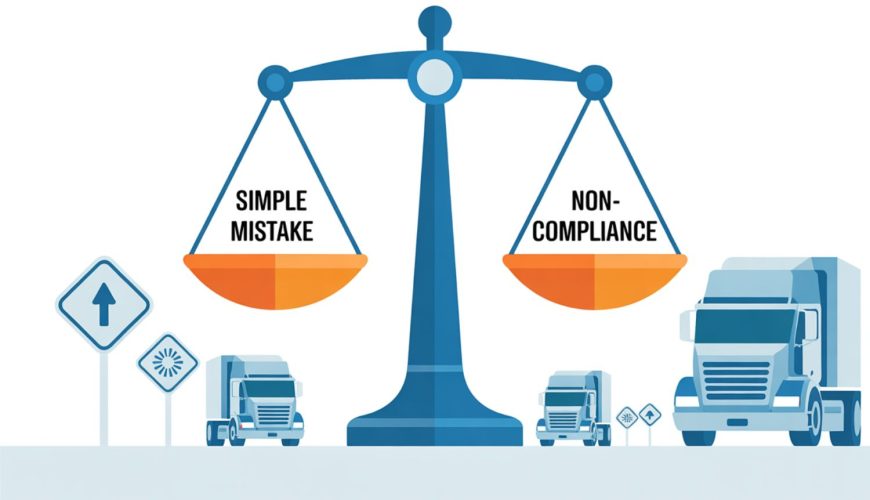
At what point does a simple mistake become non-compliance?
Because for many drivers and operators, that line does not always feel clear.
Safety matters. But context matters too.
Let’s be clear from the outset.
Safety matters. Compliance matters. Fatigue management matters.
The heavy vehicle industry carries enormous responsibility, and the vast majority of drivers understand that better than anyone.
Where frustration starts to build is when the word “non-compliance” seems to cover everything from serious safety issues right through to simple human errors.
A spelling mistake.
A clerical slip in a work diary.
A timing entry slightly off.
None of these are ideal. But they are also very different from deliberately ignoring fatigue rules or running unsafe equipment.
When everything gets grouped under the same label, people start to feel like the system is missing the reality of the job.
Not all mistakes are equal
A genuine safety breach should absolutely be taken seriously.
But a one-off paperwork error is not the same as knowingly putting lives at risk.
Drivers work in an environment where conditions change constantly. Traffic delays happen. Rest areas are not always available when you need them. Fatigue does not always follow a perfect schedule.
And yes, sometimes people make small administrative mistakes.
That does not automatically mean they are careless or unsafe.
What the industry is really asking for is a conversation that recognises the difference between human error and genuine risk.
If you don’t mind a little self-promotion…
Actually, if you don’t mind us doing a little bit of self-promotion here, this is exactly why we do what we do.
This is where a tool like Logbook Checker can make a real difference.
Most drivers are not trying to do the wrong thing. They are trying to do their job properly while staying on top of a lot of moving parts.
Logbook Checker helps by catching the small things early.
It gives drivers and operators a way to check their work diaries before those minor mistakes become costly penalties or stressful compliance issues.
Think of it as a second set of eyes on the paperwork. A simple step that helps reduce risk and keep things running smoothly.
Let’s talk about what’s really going on
This conversation is not about dismissing compliance.
It is about recognising that safety and common sense should work together.
Drivers deserve to feel heard. Operators deserve practical support. And the industry deserves a conversation that reflects the realities of the job.
Because if we want safer roads and a stronger transport industry, we need to be able to ask questions like this:
At what point does a simple mistake become non-compliance?
And how do we make sure those small mistakes do not turn into big consequences?