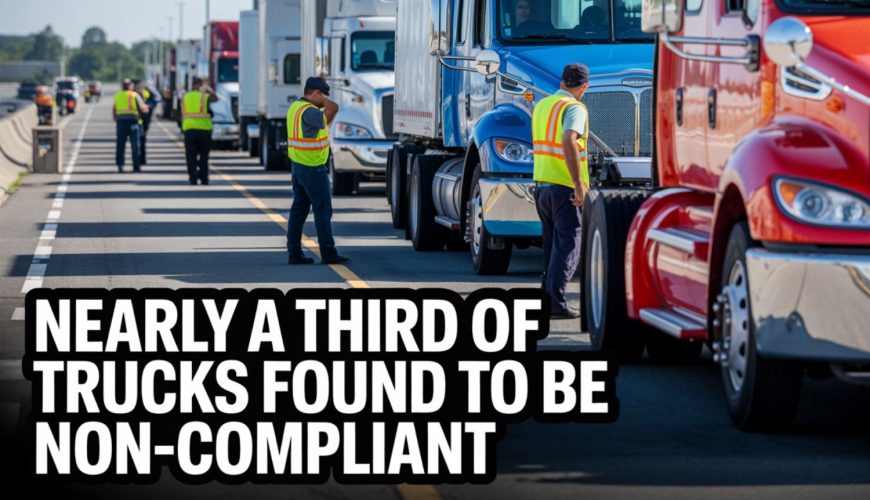
A recent joint compliance operation on Queensland’s Bruce Highway has found that almost one in three heavy vehicles intercepted were operating non-compliantly, according to the National Heavy Vehicle Regulator (NHVR).
The operation, known as Operation Overwatch, was conducted in the lead-up to the Christmas period and focused on the busy freight corridor between Maryborough and Miriam Vale.
What the Operation Involved
NHVR Safety and Compliance Officers worked alongside Queensland Police to carry out roadside inspections targeting high-risk behaviours on one of the state’s most dangerous highway sections.
In the weeks prior to the operation, three fatal crashes had already been recorded in the area, prompting a stronger enforcement and education presence.
During the operation, officers completed 143 heavy vehicle intercepts, with 49 vehicles found to be non-compliant under the Heavy Vehicle National Law (HVNL).
Key Compliance Issues Identified
Across the intercepts, officers inspected a total of 319 vehicle units, including prime movers, trailers, and dollies.
Drivers were spoken to about a wide range of compliance areas, including:
- Mechanical condition
- Vehicle dimensions
- Fatigue management
- Permits and vehicle configuration
- Loading and mass compliance
Of particular concern were 10 fatigue-related infringements, highlighting ongoing challenges around fatigue management on long regional routes.
Fatigue remains one of the most serious safety risks in the heavy vehicle industry and continues to be a major focus for regulators nationwide.
Breakdown of Enforcement Activity
Intercepts:
- Total intercepts: 143
- Non-compliant intercepts: 49
Infringements issued:
- Fatigue: 10
- Dimension: 5
- Registration: 3
- Permit and vehicle configuration: 3
- Mechanical: 3
- Mass: 2
Enforcement notices:
- Total notices issued: 72
- Defects issued: 47
- Minor defects: 44
- Major defects: 3
Industry Response
While the non-compliance figures were disappointing, the NHVR noted a positive response from drivers to the increased presence of compliance officers along the highway.
Drivers operating through known crash hot spots such as Iveragh, Gin Gin, and Miriam Vale reportedly welcomed the visibility of enforcement and education efforts.
Importantly, no crashes were recorded during the operation in the areas where officers were actively working.
What This Means for Drivers and Operators
Operations like this highlight how closely compliance and safety are linked. Fatigue, vehicle condition, and configuration issues don’t just result in penalties — they significantly increase crash risk for drivers and other road users.
For operators and drivers, the results reinforce the importance of:
- Accurate fatigue management and record keeping
- Regular vehicle checks and maintenance
- Ensuring permits and configurations are correct
- Staying informed about compliance expectations on major freight routes
At Logbook Checker, we see compliance not as red tape, but as a critical safety tool. Staying on top of fatigue, records, and vehicle compliance helps reduce risk — not just during enforcement blitzes, but every day on the road.
We’ll continue to share updates like this to help drivers and operators stay informed, compliant, and safe. updates like this to help drivers and operators stay informed, compliant, and safe.g for anyone with CoR responsibilities.